
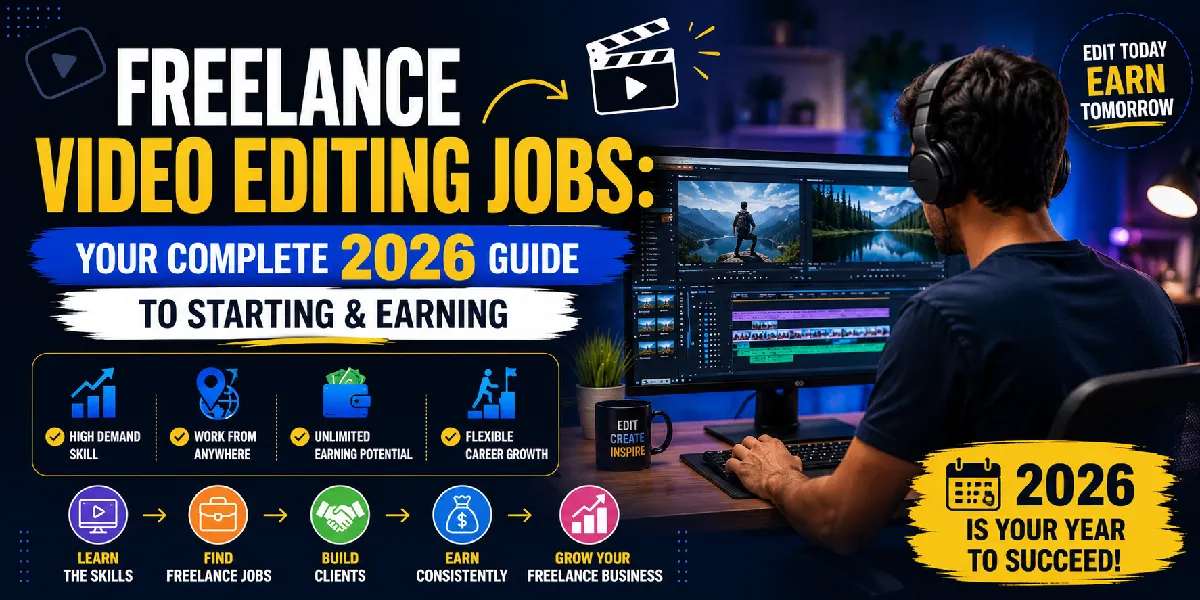
Freelance Video Editing Jobs: Your Complete 2026 Guide to Starting & Earning
The video content explosion isn't slowing down. YouTube has 2.7 billion monthly users, TikTok crosses 1.5 billion, and every business in India — from the local jeweller to the ed-tech startup — wants video content. But here is the bottleneck most people do not see: creators and businesses are drowning in footage they cannot edit.
This is where you come in.
Freelance video editing is one of the highest-demand remote skills in 2026. The global video editing services market is projected to hit $4.2 billion this year, and India's creator economy alone is adding thousands of new channels, reels, and ads every single day. Whether you are a student looking for a side hustle, a working professional wanting to switch careers, or someone who just enjoys cutting clips, freelance video editing offers a path to genuine income — often ₹20,000 to ₹1,00,000+ per month, depending on your niche and client base.
This guide walks you through everything: picking your niche, learning the tools, building a portfolio from zero, finding your first clients, pricing your work, and avoiding the mistakes that sink most beginners. If you follow the steps laid out here, you can land your first paid freelance video editing job within 8 to 12 weeks.
Why Freelance Video Editing is a Goldmine in 2026
Three forces are creating an unprecedented demand for video editors:
The Creator Economy Boom. India now has over 100 million content creators, from YouTube educators to Instagram reel makers. Most of them edit their own videos — badly, and slowly. As their channels grow, they reach a point where editing becomes the bottleneck. That is when they look for a freelance video editor.
Short-Form Video is the Default Format. Instagram Reels, YouTube Shorts, and TikTok demand a relentless pace of content. Businesses that used to post once a week now post daily. Each short video needs captions, pacing, sound design, and hooks. Brands are outsourcing this work to freelance editors.
Corporate India Needs Video. Think about it: every product demo, training session, webinar recording, testimonial, and social ad needs editing. Companies in Bangalore, Mumbai, and Delhi are hiring freelance video editors because hiring a full-time in-house editor is expensive.
The bottom line: supply of video content is growing exponentially, but supply of good editors is not keeping up. That gap is your opportunity.
Step 1: Choose Your Niche Before You Choose Your Software
The biggest mistake new freelance video editors make is calling themselves a "general video editor." That is like opening a restaurant that serves every cuisine — you end up being good at nothing.
Clients do not search for "video editor." They search for "YouTube video editor for tech channels" or "Instagram reel editor for fitness coaches." Specialisation makes you findable, memorable, and chargeable at higher rates.
Here are the most profitable niches in 2026:
YouTube Content Editing (Highest Demand)
YouTube creators need editors who understand pacing, retention graphs, chapter markers, end screens, and the unique rhythm of long-form content (8 to 20 minutes). This niche pays well but requires you to match the creator's style exactly. Beginners can start with smaller channels (1,000 to 10,000 subscribers) and grow with them.
Short-Form Content Editing (Fastest Growing)
Instagram Reels, YouTube Shorts, and TikTok. These are 15 to 90 seconds, need fast cuts, captions, trending audio, and platform-native formatting. The volume is high, turnaround is fast, and clients pay per reel. This is the easiest niche to break into because the barrier to entry is low.
Corporate & B2B Video Editing
Think product demos, testimonial videos, explainer videos, webinar clips, and training content. Clients in this niche have bigger budgets and more predictable workflows. The editing style is cleaner and less flashy. If you prefer professional work over influencer culture, this is your lane.
Wedding & Event Video Editing
India's wedding industry is massive. Wedding videographers capture hours of footage and need editors who can turn it into cinematic highlight reels. This is seasonal but highly lucrative, especially if you build relationships with wedding photographers in your city.
Podcast-to-Video Clip Editing (Emerging Golden Niche)
Podcasts are booming in India. Every podcast episode needs 5 to 10 short highlight clips for social media — with captions, dynamic waveforms, and fast pacing. Podcasters are desperate for editors who understand this format. Rates are good, and the work is repeatable.
How to Pick Your Niche
Ask yourself three questions:
What footage do I genuinely enjoy watching and editing?
Where do I have an existing interest or knowledge? (Gaming, fitness, tech, finance, weddings?)
Which niche has active, paying clients within my reach?
Pick one niche and commit to it for at least six months. You can always expand later.
Step 2: Master the Right Tools
You do not need a film degree or a ₹2 lakh editing rig. You need one piece of software that you know deeply, a decent laptop, and a few supporting tools.
Software: Free Options (Start Here)
DaVinci Resolve (Free) — Professional-grade editing, colour grading, and audio post-production. The free version is incredibly powerful. Used in Hollywood and by serious YouTubers. Best for long-form and corporate work.
CapCut Desktop (Free / ₹800 per month for Pro) — The best starting point for short-form content. One-click auto captions, built-in effects, and fast export. Many social media editors in India use CapCut exclusively.
Software: Paid Options (Upgrade When Ready)
Adobe Premiere Pro (₹1,900/month) — Industry standard for YouTube and corporate editing. Massive plugin ecosystem, seamless with After Effects. Most job listings mention Premiere Pro by name.
Final Cut Pro (₹25,000 one-time, Mac only) — Fast, intuitive, and great for solo creators. One-time purchase is easier on the wallet than monthly subscriptions.
Hardware Minimums
Processor: Intel i5 / AMD Ryzen 5 or better
RAM: 16GB minimum (32GB for 4K)
Storage: 512GB SSD or more
GPU: Dedicated graphics card (GTX 1060 or better)
Most modern laptops with these specs can handle 1080p editing comfortably. Use proxy files if you are editing 4K on a mid-range machine.
Free Learning Resources
You do not need paid courses. YouTube has everything:
DaVinci Resolve: Blackmagic's official training (free, excellent)
Premiere Pro: Justin Odisho, Premiere Basics
Short-form editing: CapCut tutorials, Peter McKinnon
Colour grading: Cullen Kelly, Darren Mostyn
Step 3: Build a Portfolio — Even With Zero Clients
You cannot get clients without a portfolio. And you cannot build a portfolio without doing the work. So do the work before you have clients.
Here is exactly how to build a professional portfolio in two weeks:
Method 1: Spec Edits (Fastest)
Take a brand you like and cut a fake ad for them. Take a YouTuber's video and re-edit it the way you would have done. Download free footage from Pexels, Pixabay, or Mixkit and assemble something that shows your style. Nobody will ask if it was a real client project when it looks great.
Method 2: Free Edits for Small Creators
Find YouTube channels with 1,000 to 5,000 subscribers whose editing clearly needs help. Offer to edit two videos for free in exchange for a testimonial and permission to use the work in your portfolio. Be specific about what you will deliver. This is the fastest way to get real client work in your portfolio.
Method 3: Create Your Own Content
Start a YouTube channel, Instagram page, or share your editing journey on LinkedIn. Edit everything yourself. This gives you continuous portfolio material AND demonstrates that you understand the creator's experience.
What Your Portfolio Needs
One 60 to 90 second showreel — Your best work, tightly cut, with music and captions
3 to 5 full-length samples — These prove you can hold attention beyond a flashy montage
A simple portfolio page — Behance, Carrd, or even a Google Drive folder works
Portfolio Checklist
Showreel (60–90 sec, niche-specific)
3 full sample edits
Before/after comparison (if applicable)
Contact information clearly visible
Hosted on a link you can share easily
Step 4: Find Freelance Video Editing Jobs
This is where most people get stuck. You have the skills, you have the portfolio, but where do you find clients? Here is the complete roadmap.
Freelance Platforms (Good for Beginners)
Upwork — Create a profile with a niche-specific headline like "YouTube Video Editor for Tech Channels." Complete your profile 100%. Only apply to jobs posted in the last 24 hours. Write personalised proposals under 150 words. Include a link to a relevant portfolio sample.
Fiverr — Create 3 gigs targeting specific outcomes. Example: "I will edit engaging YouTube Shorts for influencers." Price your first 5 orders at ₹1,500 to ₹3,000 to get reviews fast, then raise prices.
SSEVI Freelancer Section — SSEVI has a dedicated freelancer platform where you can list your video editing services and connect with clients across India. This is an excellent starting point because it is built for the Indian market with local support.
Direct Outreach (Where the Real Money Lives)
Freelance platforms work, but direct outreach puts you in control. Here is the formula:
Step 1: Identify 50 creators or businesses in your niche who clearly need better editing. Look for inconsistent posting, dips in quality, or mentions of being overwhelmed.
Step 2: Watch their content and identify one specific improvement you could make.
Step 3: Send a personalised message with a free sample edit. DM template:
"Hey [Name], I edit videos for [niche] creators. I watched your recent video on [topic] and noticed that adding jump cuts and captions could improve retention significantly. I took the liberty of re-editing a 30-second clip to show you what I mean. Here is the link. If you like it, I would love to handle your editing on an ongoing basis. Let me know what you think!"
Send 10 of these per day. Expect a 2% to 5% response rate. Follow up after 4 days if you do not hear back.
Reddit & Community Strategy
Join subreddits like r/VideoEditing, r/ForHire, r/CreatorServices, and Indian-specific communities. Do not post "looking for work" — instead, answer questions helpfully, share before/after edits, and let people come to you.
Instagram & LinkedIn Presence
Post your work regularly. Show before and after clips. Teach one editing tip per week. Over six months, this builds an inbound pipeline where clients come to you.
Step 5: Price Your Work
Pricing is the single most important business decision you will make. Get it wrong and you either work for free or scare clients away.
Pricing Models
Per Project (Recommended for Beginners): Fixed price per deliverable. Example: ₹1,500 to ₹3,000 for a 60-second Instagram Reel, ₹5,000 to ₹15,000 for a 10-minute YouTube video. This rewards speed and skill.
Hourly: ₹500 to ₹1,500 per hour depending on experience. Good for complex projects where scope is unclear. Track time with Toggl or Clockify.
Retainer (The Goal): Fixed monthly fee for a set number of deliverables. Example: ₹20,000 per month for 8 Reels + 2 YouTube videos. Retainers give you predictable income and reduce the time spent hunting for new clients.
India Rate Benchmarks (2026)
| Experience Level | Per Hour | Per 60-Second Reel | Per 10-Minute YouTube Video |
|---|---|---|---|
| Beginner (0–6 Months) | ₹300–₹600 | ₹800–₹2,000 | ₹2,000–₹5,000 |
| Intermediate (6–18 Months) | ₹600–₹1,200 | ₹2,000–₹5,000 | ₹5,000–₹15,000 |
| Advanced (18+ Months) | ₹1,200–₹3,000 | ₹5,000–₹10,000 | ₹15,000–₹40,000 |
| Expert / Specialist | ₹3,000+ | ₹10,000+ | ₹40,000+ |
The Most Important Rule
Never work for free except for one or two portfolio-building projects. Low rates attract bad clients who will drain your time and energy. Start at a respectable rate and raise it every 3 to 6 months.
Step 6: Run Your Freelance Business Properly
Freelancing is a business, not a hobby. Here is what you need:
Contracts
Use a simple contract for every project — even ₹2,000 ones. Define:
Scope of work (number of videos, length, deliverables)
Number of revision rounds (2 is standard)
Timeline and delivery dates
Payment terms (50% advance, 50% on delivery)
Late payment penalties
Tools: Bonsai, HelloBonsai, or a simple Google Docs template.
Invoicing
Send professional invoices with:
Your name/business name and GST (if registered)
Client name
Description of services
Amount and payment terms
Bank or UPI details
Taxes for Indian Freelancers
Register for GST if your annual turnover exceeds ₹20 lakh
Set aside 20% to 25% of every payment for taxes
File quarterly GST returns and annual income tax
Track every business expense: software subscriptions, internet bills, hardware, electricity — all are deductible
Client Communication
Use Frame.io or Google Drive for sharing drafts
Get feedback in writing
Never send a final high-res file until payment is received (use watermarked previews)
Common Mistakes That Kill Freelance Video Editing Careers
Mistake 1: Not Specialising
"If I say I can do everything, I am an expert at nothing." A specific niche gets you clients faster than a general "video editor" tagline.
Mistake 2: Underpricing
At ₹200 per reel, you are earning less than minimum wage after software costs, electricity, and editing time. Start at a rate that respects your time.
Mistake 3: No Contract
Scope creep will destroy your profit. A client who asks for "just one more change" five times will turn a profitable project into a loss. Contracts protect you.
Mistake 4: Relying Only on Platforms
If Upwork or Fiverr changes its algorithm tomorrow, your income vanishes. Build a direct client pipeline alongside platform work.
Mistake 5: Delivering Without Getting Paid First
Watermark your previews. Require an advance. You deliver quality work, but you also deserve to be paid for it.
Final Takeaway: Your First 30 Days
Here is your exact plan for the next month:
Week 1: Download DaVinci Resolve or CapCut. Complete 10 hours of YouTube tutorials. Edit your first practice video.
Week 2: Edit 3 to 5 portfolio samples in your chosen niche. Create a 60-second showreel. Set up your portfolio page.
Week 3: Create profiles on Upwork, Fiverr, and SSEVI Freelancer. Write niche-specific headlines. Start sending 10 outreach messages per day.
Week 4: Apply to 20+ freelance video editing jobs. Follow up on outreach. Offer one free edit to a small creator for a testimonial. Land your first paid client.
The gap between reading this guide and editing your first video is the most important distance in your freelance career. Close it this week.
And when you are ready to find your first freelance video editing jobs, remember that SSEVI connects freelancers with clients across India — from individual creators to businesses looking for reliable video editors. List your services, build your profile, and start connecting with clients who need exactly what you offer.
Your freelance video editing career starts now. Not next month. Not when you feel ready. Now.
Ready to find freelance video editing jobs? Visit SSEVI Freelancer to create your profile and connect with clients across India.





Discussion
0Share your thoughts and engage with the community
No comments yet
Be the first to share your thoughts!